
How we help
Four stages, and you may not need all of them. We start where you are and build on what already works. Timings are rough and depend on your data and systems.
Stage 1: Learn the business
Usually 1 to 2 weeks
Business & Data Assessment
- How you make money and where decisions get made
- Your systems, data, and reporting today
- Where your notes, docs, and threads live
- A prioritized plan with timelines
Stage 2: Build the foundation
Usually 4 to 10 weeks
AI-Ready Data Build
Your key systems flowing into one place automatically, checked every time they refresh.
- Pipelines from your key systems
- A warehouse sized to your data
- Tested data models
Data Acquisition
When the data you need isn’t in your systems, we go find it, buy it or start collecting it.
- Public and third-party data, like demographics and market data
- Data vendors compared before you buy
- Lead and account lists built from your CRM and outside data
- New CRM and ATS fields when the data has to start with you
- Facts pulled from emails, calls and PDFs with AI, then checked
Context Layer
The why behind your numbers. Notes and calls become searchable, so answers come with the story.
- Notes, transcripts, and threads, synced on a schedule
- Each linked to a metric, customer, and date
- Who sees which notes, agreed with you up front
- Answers that can cite the note behind them
KPI & Semantic Layer
Every key number defined once, so every report and every AI answer matches.
- A metric dictionary, reviewed with finance
- Business terms defined in plain English
- Defined once in code (dbt, Cube or your warehouse), so dashboards and AI match
- Changes versioned and tested
Metric dictionary
| Metric | Definition | Owner | |
|---|---|---|---|
| Gross margin | (Revenue − Cost of goods) ÷ Revenue | Finance | Reviewed |
| Revenue | Invoiced, net of refunds and credits | Finance | Reviewed |
| Active customer | Paid an invoice in the last 90 days | Sales ops | Reviewed |
| Qualified pipeline | Open deals past discovery | Sales | Reviewed |
Used by DashboardsAI AnalystBoard pack
Illustrative mock data
Data Migration
Moving to a new CRM, ERP or accounting system? We handle the data side, so your history comes with you and the new system starts clean.
- Old fields mapped to the new system and signed off by the people who use them
- Duplicates and old records cleaned up before the move
- Test loads checked until counts and totals match
- History kept in your warehouse, with a way back if cutover goes wrong
Why the foundation comes first
“Can’t we just upload our spreadsheets to ChatGPT?” It’s a good start. But a spreadsheet is a snapshot, and the AI has to guess what your numbers mean. A data foundation keeps them current and defined once, so it doesn’t have to guess.
Stage 3: Put AI to work
Usually 2 to 4 weeks once the foundation is in place
Dashboards & Insights
The numbers you check every week in one place, with what changed and why.
- Dashboards on governed metrics, in the BI tool you use
- Weekly KPI digest and monthly CFO brief, with commentary
- Alerts when a metric moves, with likely drivers to check
- Sponsor and board reporting packs
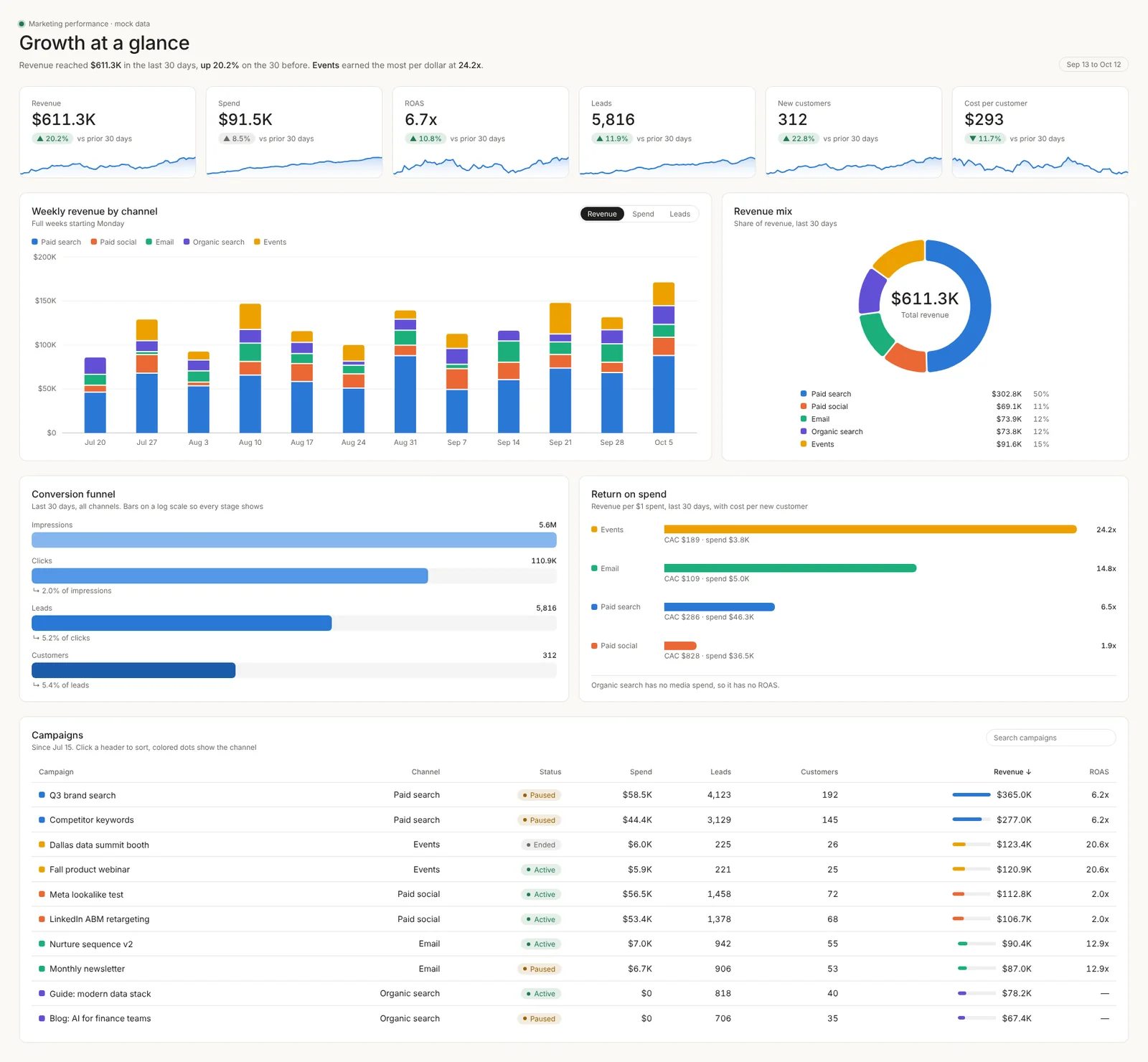
Growth at a glance
Last 30 days · mock data
- Revenue
- $611.3K
- ▲ 20.2%
- Spend
- $91.5K
- ▲ 8.5%
- Return on spend
- 6.7x
- ▲ 10.8%
- Leads
- 5,816
- ▲ 11.9%
- New customers
- 312
- ▲ 22.8%
- Cost per customer
- $293
- ▼ 11.7%
Revenue per $1 spent
Open the full dashboardAI Analyst
Your team asks questions in plain English and gets answers from the numbers you’ve agreed on.
- Built on Claude, ChatGPT, or similar, in your accounts
- Your team owns the account and can switch it off
- Sees approved metrics only, through a standard connector (MCP)
- Read-only, each team sees only its own data, and queries are logged where your warehouse allows
- Test questions re-run when your data changes
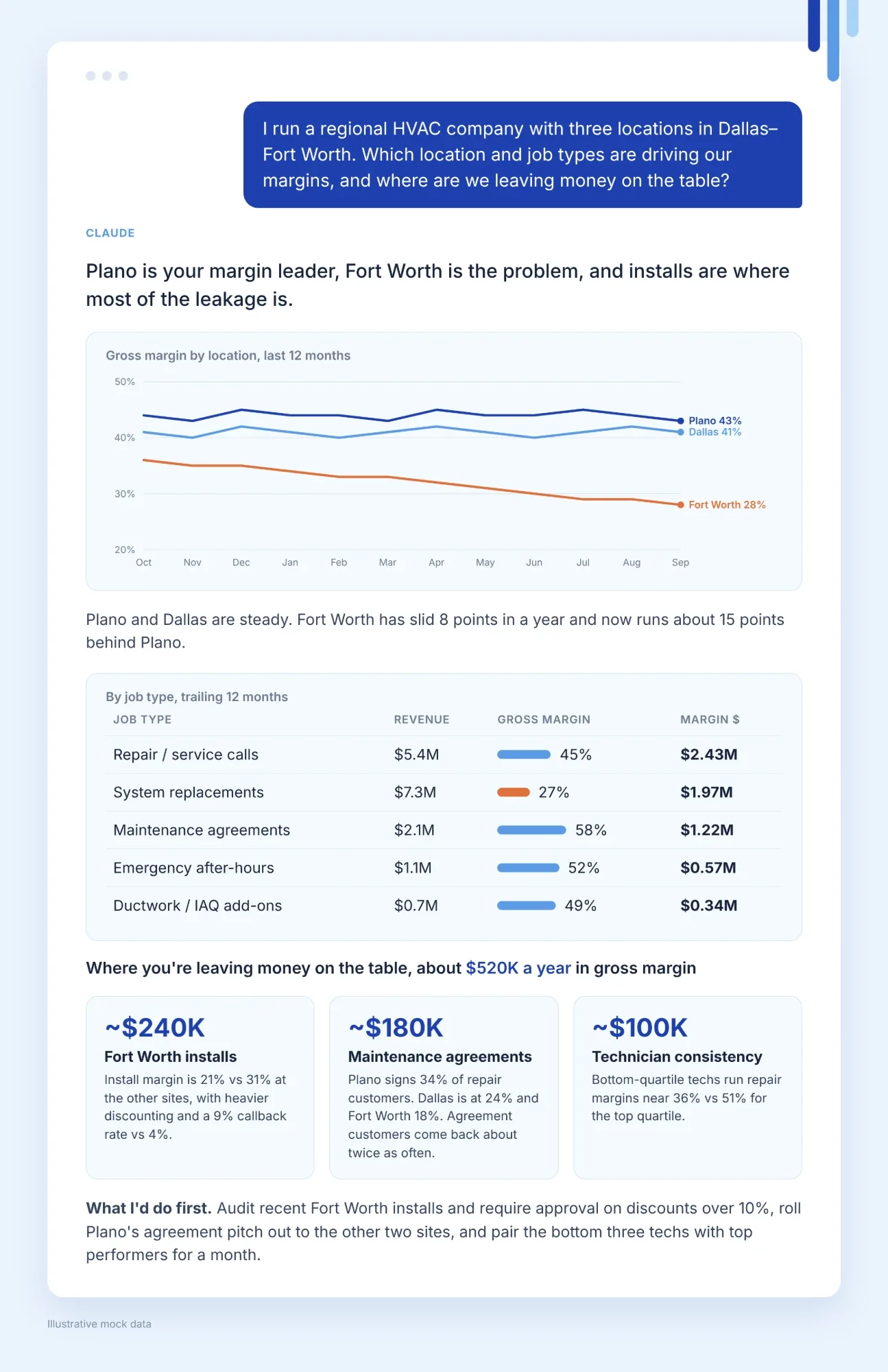
Machine Learning
Forecasts and scores that show what’s likely to happen next. Best with a couple of years of history for forecasts and a few hundred past outcomes for scores.
- Revenue, volume, and cash forecasts
- Lead and deal scoring in your CRM
- Churn, risk, and anomaly detection
- Monitoring and retraining planned before hand-over
Data Activation
Your data put to work in campaigns, sales follow-up and outreach. Set up in your own accounts, and every sync has an owner, a log and an off switch.
- Audiences built from what customers bought, like repeat buyers or ones about to lapse
- Segments synced to your ad and email tools on a schedule, not by hand
- Prospect lists ranked against your best customers and loaded into your CRM
- Scores and account details right on the CRM record
- Sales sent back to ad platforms so they optimize for buyers, not clicks
Stage 4: Keep it running
Month to month, for as long as it helps
Data Team on Retainer
We keep what we built healthy as your business changes.
- Pipeline monitoring and fixes
- Warehouse, model and test upkeep, plus cost reviews
- New sources, metrics and reports as priorities change
- Testing and retraining for AI and ML models
Fractional Head of Data
Senior data leadership, part time, without a full-time hire.
- A data and AI roadmap tied to your business goals
- Direction for your in-house team, contractors or vendors
- Advice on data hires, tools and vendors
What this looks like in practice
Questions a team might bring us, and what we’d connect and build to answer them. Examples, not client work.
Which campaigns turn into revenue, not just leads?
Google Ads, Meta, direct mail drops and response codes, and your CRM.
What we build- Attribution from first touch to closed deal
- Direct mail match-back
- Cost per closed deal by channel
Which deals will close this quarter, and where do they stall?
Your CRM, call and email activity, and quotes.
What we build- Pipeline conversion and speed by stage
- Forecast vs. commit
- Rep scorecards
- Alerts on stalled deals
Which sources produce hires who stay?
Your ATS (Greenhouse, Lever, Bullhorn), job board spend, and your HRIS.
What we build- Source of hire through 90-day retention
- Cost per hire by source
- Recruiter scorecards on time to fill and offer acceptance
Which customers and products make money after every cost?
Your accounting or ERP system, billing, and your CRM.
What we build- Margin by customer and product
- A cash forecast
- A monthly CFO brief
Which accounts are about to churn, and which are ready to expand?
Billing, product usage, and support tickets.
What we build- Churn risk scores in your CRM
- Expansion signals
- Account health
Focused Projects
Have one question, not a build? We take on fixed-scope, fixed-fee projects, like a lead list from your CRM or tying deals to the campaigns behind them. Done in your tools, and you keep the work.
Not sure where to start?
That’s what the Assessment is for.